In today’s highly competitive and rapidly evolving business environment, organizations can no longer rely solely on instinct, traditional methods, or short-term growth strategies. Modern enterprises need a smarter and more responsible approach, one that combines the power of data with long-term sustainability. A data-driven and sustainable business is not just a trend; it is a strategic necessity for companies that want to stay relevant, efficient, profitable, and future-ready.
Data has become one of the most valuable assets for businesses of all sizes. It helps organizations understand customer behavior, improve operations, predict market changes, reduce risks, and make informed decisions. At the same time, sustainability has emerged as a critical pillar of business success. Customers, investors, regulators, and stakeholders increasingly expect businesses to minimize environmental impact, use resources responsibly, and operate ethically.
When businesses combine data-driven decision-making with sustainability-focused strategies, they unlock a powerful advantage. They can identify inefficiencies, optimize resource usage, improve customer satisfaction, reduce waste, and build a resilient brand that thrives in the long run. Whether you are a startup, SME, or enterprise, building a data-driven and sustainable business can transform the way you operate and grow. In this blog, we wil explore the essential steps businesses should follow to create a strong foundation for data-driven growth while embedding sustainability into their operations and long-term vision.
Key Takeaways
- Using data-driven insights helps businesses make smarter, faster, and more accurate decisions.
- Sustainability plays a key role in building long-term business growth and operational resilience.
- The right technology and analytics tools improve efficiency, performance, and resource management.
- Tracking clear KPIs helps measure business success and sustainability progress effectively.
- Continuous improvement and innovation help businesses stay competitive and future-ready.
Why Businesses Need a Data-Driven and Sustainable Approach
Before diving into the steps, it’s important to understand why this approach matters so much. A data-driven business uses insights, analytics, and measurable information to guide decisions rather than assumptions. This improves accuracy, agility, and performance across departments. Sustainability, on the other hand, ensures that business growth does not come at the expense of the environment, society, or future resources.
Together, these two elements help businesses:
- Make faster and smarter decisions
- Reduce operational waste and unnecessary costs
- Improve energy and resource efficiency
- Better understand customer preferences and market demand
- Strengthen brand trust and reputation
- Meet compliance and ESG expectations
- Increase resilience against market disruptions
- Support long-term profitability and responsible innovation
A company that uses data to track sustainability performance can continuously improve, measure results, and adapt its strategies with confidence.
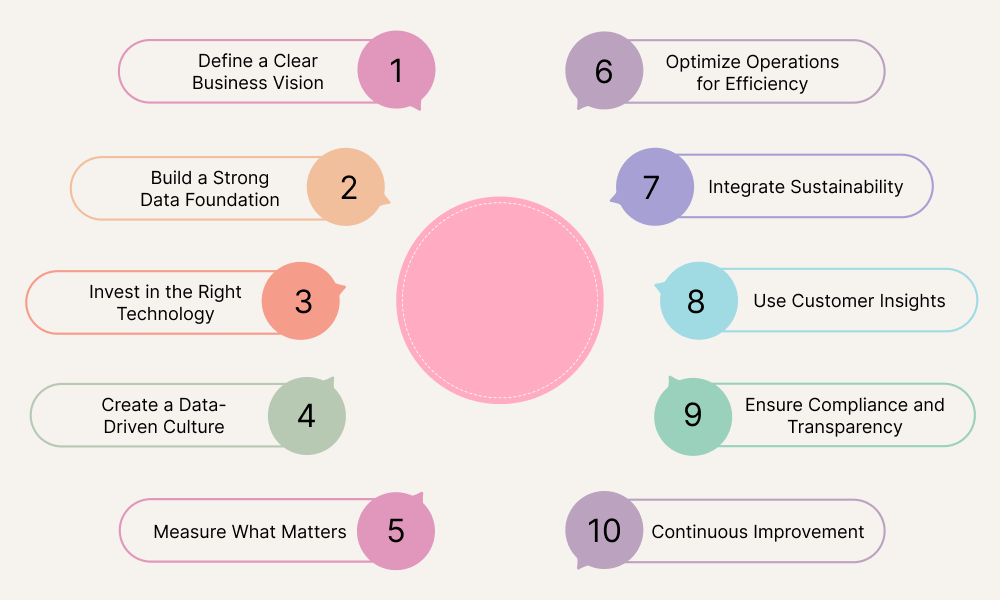
Essential Steps for Building a Data-Driven and Sustainable Business
Here are the essential steps for building a sustainable business.
1. Define a Clear Business Vision
The first step in building a data-driven and sustainable business is to establish a clear vision. Your business needs to define what success looks like, not only in terms of revenue and market share, but also in terms of sustainability, efficiency, and long-term impact. This means setting goals that align business performance with environmental and social responsibility. For example, a company may aim to reduce carbon emissions, improve supply chain transparency, cut down on waste, or increase the use of renewable resources.
when setting these goals, they should be:
- Specific and measurable
- Aligned with company values
- Realistic and time-bound
- Supported by relevant data
- Connected to broader business outcomes
Without clear goals, data becomes overwhelming and sustainability efforts may remain vague or inconsistent. A well-defined strategy gives direction and helps teams understand what they are working toward.
2. Build a Strong Data Foundation
A data-driven business starts with quality data. If your data is incomplete, inconsistent, outdated, or siloed across departments, decision-making becomes unreliable.
To build a strong data foundation, businesses must identify what data they need, where it comes from, how it is stored, and how it will be used. This may include data from sales, marketing, finance, operations, customer support, supply chains, manufacturing, energy usage, and sustainability reporting systems.
Key actions include:
- Centralizing data from multiple sources
- Standardizing formats and definitions
- Eliminating duplicate or inaccurate records
- Implementing data governance policies
- Ensuring data security and privacy compliance
- Making data accessible to relevant teams
A centralized and organized data ecosystem allows businesses to uncover meaningful insights and avoid fragmented decision-making. The stronger your data infrastructure, the easier it becomes to support sustainable operations with real evidence.
3. Invest in the Right Technology
Once the data foundation is in place, businesses need the right tools to collect, process, analyze, and visualize that data. Technology is the backbone of a modern data-driven and sustainable enterprise.
Companies should invest in solutions such as:
- Business intelligence (BI) platforms
- Data analytics and reporting tools
- Cloud-based data management systems
- AI and machine learning solutions
- IoT devices for real-time monitoring
- ERP and CRM systems
- Sustainability tracking and ESG reporting tools
For example, IoT sensors can monitor energy usage in facilities, while analytics dashboards can reveal where waste is occurring in production or logistics. AI can help predict demand more accurately, reducing overproduction and excess inventory. Cloud platforms can improve collaboration and reduce dependence on inefficient legacy systems.
The goal is not to adopt technology for the sake of innovation, but to choose tools that directly support better decisions, operational efficiency, and sustainability objectives.
4. Create a Data-Driven Culture
Technology alone cannot create a data-driven business. The real transformation happens when people across the organization begin to trust, understand, and use data in their everyday decision-making. A data-driven culture means that employees at all levels, from leadership to operational teams, rely on insights rather than assumptions. It also means fostering transparency, accountability, and continuous learning.
To create this culture, businesses should:
- Train employees in data literacy
- Encourage cross-functional collaboration
- Make dashboards and reports easy to understand
- Reward evidence-based decision-making
- Promote experimentation and continuous improvement
- Involve leadership in championing data use
When teams understand how data connects to sustainability and business outcomes, they become more engaged in identifying opportunities for improvement. A strong culture ensures that data is not limited to analysts or executives—it becomes a shared asset across the organization.
5. Measure What Matters
One of the biggest mistakes businesses make is collecting too much data without focusing on the right metrics. To become truly data-driven and sustainable, organizations must define key performance indicators (KPIs) that reflect both business performance and sustainability impact.
These KPIs should be aligned with your goals and easy to track over time.
Wxamples of business-focused KPIs include:
- Revenue growth
- Customer acquisition cost
- Customer lifetime value
- Conversion rates
- Operational efficiency
- Inventory turnover
- Profit margins
The purpose of KPIs is to create visibility. When businesses track the right metrics, they can see what is working, where they are falling behind, and what changes are needed. Data-backed KPIs also make it easier to communicate progress to stakeholders, investors, and customers.
6. Optimize Operations for Efficiency
A sustainable business is an efficient business. Data can reveal hidden inefficiencies in operations that lead to wasted resources, higher costs, and unnecessary environmental impact.
By analyzing operational data, businesses can improve:
- Energy consumption in offices and production facilities
- Transportation and logistics routes
- Supply chain efficiency
- Equipment maintenance schedules
- Production planning and demand forecasting
- Resource allocation across departments
- Inventory management and waste control
For example, predictive analytics can reduce equipment downtime by identifying maintenance needs before failures happen. Route optimization tools can lower fuel use and delivery times. Demand forecasting can reduce overstocking and waste in retail or manufacturing.
7. Integrate Sustainability
A business cannot be truly sustainable if its supply chain is not aligned with responsible practices. Supply chains often represent a major source of environmental and social impact, from raw material sourcing to manufacturing, packaging, and distribution.
Data can help businesses gain visibility into their supply chains and identify risks, inefficiencies, or compliance gaps.
Important steps include:
- Tracking supplier performance with measurable criteria
- Evaluating environmental and ethical sourcing practices
- Monitoring transportation emissions and packaging waste
- Identifying opportunities for local sourcing
- Assessing labor practices and compliance standards
- Using digital tools for supply chain transparency
Businesses that integrate sustainability into supply chain management are better positioned to reduce risk, meet customer expectations, and build stronger, more resilient supplier relationships.
8. Use Customer Insights
Customers are increasingly choosing brands that align with their values. This makes customer data a powerful tool for building both better products and more sustainable business models. By analyzing customer behavior, feedback, purchase trends, and preferences, businesses can:
- Identify demand for eco-friendly products or services
- Reduce unnecessary packaging
- Improve product lifecycle planning
- Design more efficient service delivery models
- Launch circular economy initiatives like reuse or recycling programs
- Personalize offerings to reduce waste and improve satisfaction
Data-driven customer insights help businesses innovate with purpose. Instead of guessing what customers want, organizations can use evidence to develop sustainable solutions that are both valuable and profitable.
9. Ensure Compliance and Transparency
As sustainability becomes a boardroom priority, businesses are facing increasing pressure to report on environmental, social, and governance (ESG) performance. Regulations, investor expectations, and customer demands are all pushing companies toward greater transparency. A data-driven business is better equipped to meet these expectations because it can accurately track and report on key metrics. Businesses should establish governance frameworks that include:
- Data privacy and security standards
- ESG reporting processes
- Ethical AI and analytics usage
- Internal audit and accountability mechanisms
- Compliance with environmental regulations
- Clear ownership of sustainability metrics
Strong governance ensures that both data and sustainability initiatives are credible, measurable, and trustworthy. It also reduces legal and reputational risks.
10. Continuous Improvement
Building a data-driven and sustainable business is not a one-time project. It is an ongoing journey of learning, adapting, and improving.
Markets change, customer expectations evolve, technologies advance, and sustainability challenges become more complex. Businesses that succeed are those that treat data and sustainability as living strategies rather than fixed goals. To support continuous improvement:
- Regularly review performance data
- Reassess KPIs and business goals
- Test new technologies and processes
- Encourage innovation across teams
- Benchmark against industry standards
- Learn from customer and stakeholder feedback
- Scale what works and refine what doesn’t
Continuous improvement allows businesses to stay agile, competitive, and responsible in a changing world.
Benefits of Building a Data-Driven and Sustainable Business
Building a data-driven and sustainable business helps organizations improve performance, reduce risks, and create long-term value. By combining data insights with responsible business practices, companies can make smarter decisions, optimize resources, and strengthen their market position. Below are some of the key benefits:
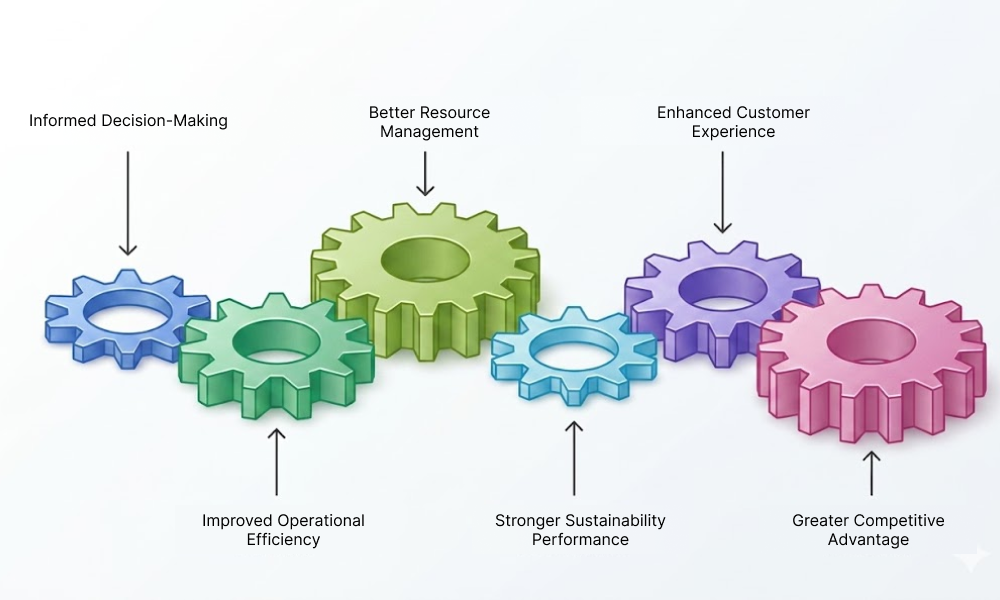
1. Informed Decision-Making
A data-driven business relies on accurate insights instead of assumptions, which leads to better strategic and operational decisions. When sustainability goals are also backed by data, businesses can identify what works best and where improvements are needed.
- Enables faster and more accurate business decisions
- Reduces guesswork and minimizes costly mistakes
- Helps leaders identify trends and opportunities early
- Improves planning with real-time and historical data
- Supports evidence-based sustainability strategies
2. Improved Operational Efficiency
One of the biggest benefits of using data is the ability to uncover inefficiencies across operations. Businesses can streamline workflows, optimize processes, and reduce waste while improving productivity and output.
- Identifies bottlenecks in business processes
- Improves workflow automation and resource allocation
- Reduces downtime through predictive maintenance
- Enhances inventory and supply chain management
- Increases productivity across departments
3. Better Resource Management:
A sustainable and data-driven approach helps businesses cut unnecessary expenses by monitoring energy usage, material consumption, logistics, and other operational costs. This leads to better financial performance and more responsible resource use.
- Lowers energy and utility costs
- Reduces material waste and overproduction
- Optimizes transportation and logistics expenses
- Improves budget planning and cost forecasting
- Promotes efficient use of resources across the business
4. Stronger Sustainability Performance
Businesses that integrate sustainability with data can measure environmental impact more effectively and take meaningful action to improve. This helps organizations meet their environmental and social goals while staying accountable.
- Tracks carbon emissions and energy consumption
- Measures waste reduction and recycling efforts
- Supports responsible sourcing and supply chain transparency
- Helps achieve ESG and sustainability targets
- Improves environmental accountability and reporting
5. Enhanced Customer Experience
Modern customers prefer brands that are both innovative and responsible. Data helps businesses understand customer needs better, while sustainability strengthens trust and brand reputation.
- Delivers more personalized customer experiences
- Helps identify changing customer preferences
- Builds trust through responsible business practices
- Strengthens customer loyalty and retention
- Improves brand perception in competitive markets
6. Greater Competitive Advantage
Businesses that use data intelligently and adopt sustainable practices often outperform competitors. They are better prepared to adapt to market changes, customer expectations, and industry regulations.
- Helps businesses stay ahead of market trends
- Increases agility in changing business environments
- Differentiates the brand through innovation and responsibility
- Supports faster response to industry disruptions
- Creates a stronger position in the marketplace
Common Challenges Businesses Face
While the benefits are substantial, building a data-driven and sustainable business can come with challenges, such as:
- Poor data quality or disconnected systems
- Resistance to organizational change
- Lack of data skills within teams
- Difficulty measuring sustainability outcomes
- High initial investment in technology
- Limited visibility into supply chain operations
- Unclear ownership of data and ESG initiatives
The good news is that these challenges can be overcome with the right strategy, expert support, and phased implementation. Businesses do not need to transform overnight. The key is to start with a strong foundation and build gradually.
Conclusion
At jiWeb Technologies, we believe that building a successful modern business requires more than just growth, it requires intelligence, adaptability, and responsibility. A data-driven and sustainable business model empowers organizations to make informed decisions, improve operational efficiency, reduce waste, and create online software solutions for customers.
By leveraging the right technologies, actionable insights, and sustainable strategies, businesses can stay competitive while contributing to a better future. We help organizations transform their operations with innovative digital solutions that support smarter decisions and sustainable growth. The path to long-term success starts with the right data, the right strategy, and the right software development partner. Contact us to learn more.
Frequently Asked Questions
1. What is a data-driven and sustainable business?
A data-driven and sustainable business is an organization that uses data and analytics to make informed decisions while also focusing on long-term environmental, social, and operational responsibility. It combines business intelligence with sustainability practices to improve efficiency, reduce waste, and support long-term growth.
- Uses data instead of assumptions for business decisions
- Tracks performance with measurable KPIs
- Focuses on reducing waste and improving resource efficiency
- Aligns business growth with environmental and social responsibility
- Supports long-term resilience and profitability
2. Why is data important for building a sustainable business?
Data helps businesses identify inefficiencies, measure sustainability performance, and make smarter decisions that reduce environmentalimpact while improving operations. Without data, sustainability efforts can become inconsistent, hard to track, and difficult to improve over time.
- Measures energy, water, and resource consumption
- Tracks waste generation and reduction efforts
- Improves supply chain visibility and accountability
- Helps forecast demand and reduce overproduction
- Provides evidence for ESG reporting and compliance
3. What are the first steps to becoming a data-driven business?
The first steps include defining clear business goals, identifying relevant data sources, improving data quality, and implementing tools that help collect and analyze information. Businesses also need leadership support and a culture that values evidence-based decision-making.
- Set clear business and sustainability objectives
- Audit existing data sources and systems
- Clean and organize business data
- Invest in analytics or reporting tools
- Train teams to understand and use data effectively
4. Which technologies help create a data-driven and sustainable enterprise?
Several technologies can support this transformation, including cloud platforms, BI tools, AI, machine learning, IoT devices, ERP systems, CRM software, and ESG reporting platforms. The right mix depends on the business model, industry, and sustainability goals.
- Business intelligence dashboards for reporting
- Cloud solutions for centralized data management
- AI and machine learning for predictive insights
- IoT sensors for monitoring resource usage
- ERP/CRM systems for integrated business operations
5. How can businesses measure sustainability performance effectively?
Businesses can measure sustainability by setting relevant KPIs and tracking them consistently over time. These metrics should align with company goals and cover environmental, operational, and governance areas.
- Carbon emissions and energy consumption
- Water usage and waste reduction rates
- Recycling and reuse percentages
- Sustainable sourcing performance
- Supplier compliance and ESG benchmarks