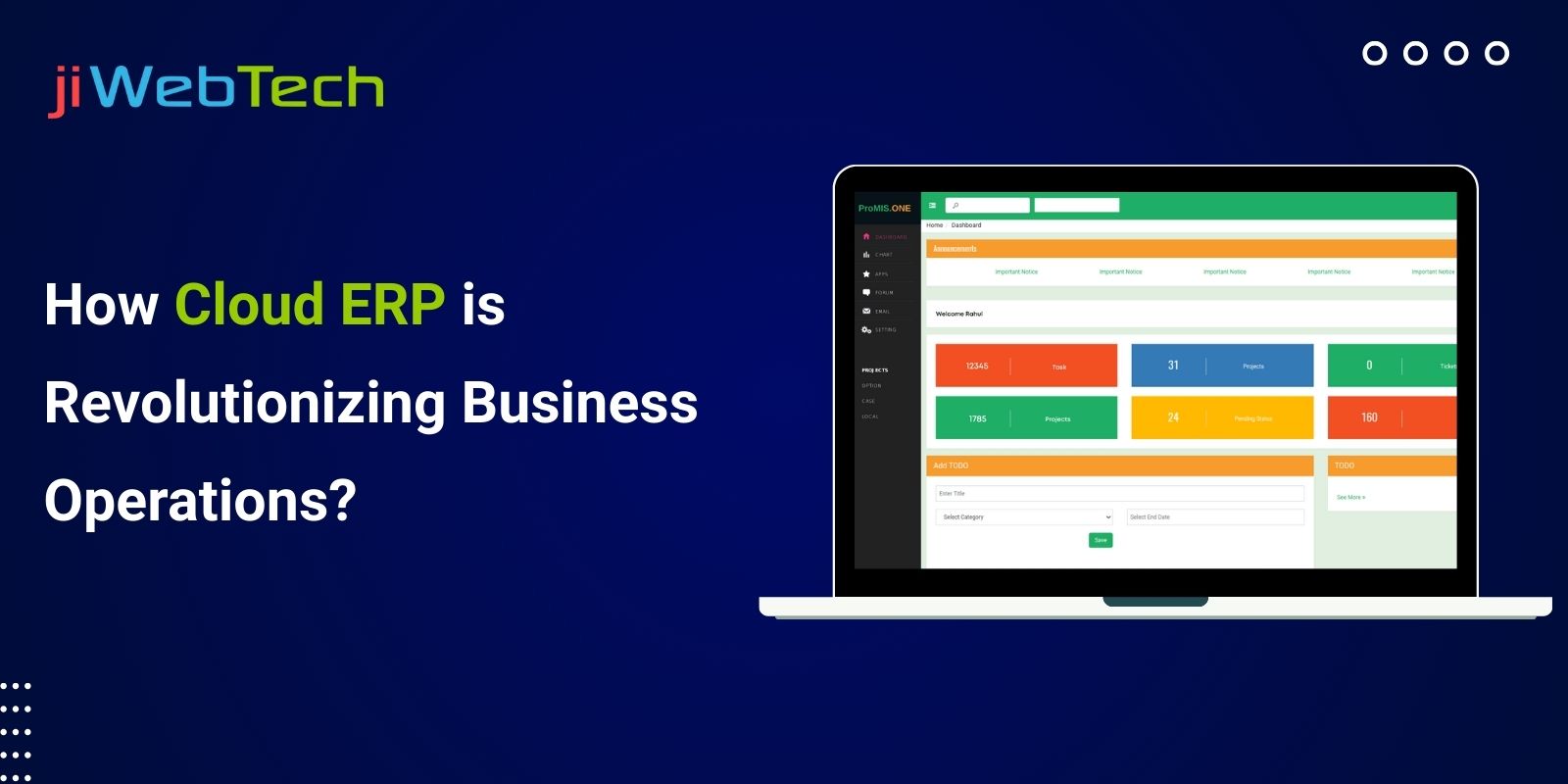
In today’s fast-paced business environment, enterprises must constantly adapt to stay competitive. Research shows that by 2026, over 60% of global ERP deployments will be cloud-based. This shift is driven by the growing demand for agile, scalable, and cost-effective solutions that enable real-time decision-making and seamless collaboration. Cloud ERP systems are revolutionizing how enterprises manage their operations by integrating critical business processes into a single, accessible platform hosted on the cloud.
According to a McKinsey report, organizations adopting cloud ERP have seen operational cost reductions of up to 30% and improved productivity by 20-30%. This blog will explore how Cloud ERP is reshaping enterprise operations, unlocking efficiencies, driving innovation, and enabling businesses to meet the demands of a digital-first world.
In this blog, we will explore how cloud ERP is revolutionizing enterprise operations, its benefits, and why companies are increasingly adopting it to stay competitive.
Key Takeaways
- Cloud ERP improves business agility by allowing easy scalability without costly infrastructure investments.
- Real-time data access through cloud ERP enhances collaboration and speeds up decision-making across departments.
- By shifting to cloud ERP, enterprises reduce IT maintenance burdens and convert capital expenses into manageable operational costs.
- Leading cloud ERP vendors prioritize security and compliance, making data handling safer than many legacy on-premises solutions.
- Integration of AI and analytics in cloud ERPs drives innovation, helping businesses optimize processes and gain competitive advantages.
- Cloud ERP’s disaster recovery and business continuity features ensure enterprise resilience against disruptions.
Understanding Cloud ERP
ERP systems have long been essential tools for businesses to integrate various operational processes, such as finance, supply chain, human resources, and customer relationship management. Traditional ERP systems required significant upfront investment in hardware, software, and IT maintenance. Moreover, updates and scalability were often cumbersome, slowing down business agility.
Cloud ERP, on the other hand, is hosted on remote servers and delivered through the internet. This allows businesses to access their ERP system from anywhere, at any time, without the need for heavy infrastructure. Providers manage updates, security, and backups, reducing the burden on internal IT teams.
Key Ways Cloud ERP is Transforming Enterprise Operations
Here’s how Cloud ERP is changing the enterprise operations:
1. Enhanced Flexibility and Scalability:
Cloud ERP enables enterprises to scale their operations effortlessly. Whether a company is expanding to new markets or launching new products, cloud ERP can adapt to changing business needs. Unlike traditional ERP systems, which require physical upgrades, cloud-based solutions allow businesses to increase or decrease resources based on demand.
This flexibility ensures that enterprises remain agile in a rapidly evolving market.
2. Cost Efficiency:
One of the most significant advantages of cloud ERP is cost savings. Organizations no longer need to invest heavily in servers, software licenses, or IT maintenance. Cloud ERP is typically offered as a subscription model (SaaS – Software as a Service), which allows businesses to pay for what they use. Moreover, automatic updates reduce the cost of manual system maintenance.
3. Real-Time Data and Analytics:
Data-driven decision-making is at the core of modern business success. Cloud ERP systems provide real-time insights across departments, enabling managers to make informed decisions quickly. From sales forecasting to inventory management and financial planning, real-time analytics ensures that businesses are always ahead of the curve.
4. Improved Collaboration:
In traditional ERP setups, teams often operate in silos, leading to inefficiencies. Cloud ERP fosters collaboration across departments by providing a unified platform where employees can access the same data. Whether your sales, finance, or operations team, everyone works with a single source of truth, enhancing productivity and reducing errors.
5. Enhanced Security and Compliance:
Security remains a top concern for enterprises adopting cloud technology. Reputable cloud ERP providers implement robust security protocols, including encryption, multi-factor authentication, and regular security audits. Additionally, cloud ERP can help organizations remain compliant with industry regulations by providing audit trails, data protection measures, and automated compliance reporting.
6. Seamless Integration with Other Tools:
Modern enterprises rely on a variety of software tools for CRM, HR, marketing, and supply chain management. Cloud ERP systems are designed to integrate seamlessly with other business applications, enabling a connected ecosystem. This integration not only improves workflow efficiency but also ensures data consistency across the organization.
7. Remote Accessibility:
The rise of remote work has made accessibility a critical factor for business operations. Cloud ERP allows employees to access vital business information from anywhere, using any device with internet connectivity. This remote capability ensures that operations continue uninterrupted, even in times of crisis.
Industries Benefiting from Cloud ERP
Cloud ERP is versatile and has proven transformative across a wide range of industries. By centralizing operations and providing real-time insights, businesses can reduce costs, enhance efficiency, and make data-driven decisions.
Here’s a closer look at how cloud ERP impacts different sectors:
1. Manufacturing
Manufacturers often deal with complex supply chains, production schedules, and inventory management challenges. Cloud ERP helps:
- Optimize production planning and scheduling to reduce downtime.
- Track inventory in real time, preventing overstocking or stockouts.
- Automate procurement and vendor management processes.
- Provide predictive analytics for demand forecasting, helping manufacturers meet customer demand efficiently.
2. Retail and E-commerce
Retail businesses face intense competition and require quick adaptability. Cloud ERP assists by:
- Managing inventory across multiple locations and online channels.
- Providing real-time sales analytics and customer insights.
- Streamlining order processing, returns, and logistics.
- Enhancing customer experience through better demand forecasting and personalized offerings.
3. Healthcare
Healthcare organizations must balance patient care with regulatory compliance and operational efficiency. Cloud ERP can help by:
- Centralizing patient records and ensuring secure data management.
- Automating billing, insurance claims, and financial management.
- Maintaining compliance with healthcare regulations such as HIPAA.
- Optimizing supply chain management for medical equipment and pharmaceuticals.
4. Finance and Banking
The finance sector operates in a highly regulated environment that demands accuracy, transparency, and efficiency. Cloud ERP benefits include:
- Streamlining financial reporting and auditing processes.
- Automating accounting tasks like accounts payable/receivable.
- Improving cash flow management and expense tracking.
- Ensuring compliance with global financial regulations.
5. Logistics and Supply Chain
In logistics, visibility, speed, and accuracy are critical. Cloud ERP offers:
- Real-time tracking of shipments, vehicles, and inventory.
- Optimization of warehouse management and route planning.
- Integration with suppliers and third-party logistics providers.
- Improved forecasting to prevent bottlenecks and delays.
- Logistics companies can streamline operations, reduce transportation costs, and enhance customer satisfaction through real-time data and predictive analytics.
6. Education
Educational institutions are increasingly adopting cloud ERP to manage administration, student data, and academic operations. Benefits include:
- Centralized management of student admissions, grades, and attendance.
- Streamlined financial management, including tuition and scholarship tracking.
- Better resource allocation for classrooms, staff, and facilities.
- Enhanced communication between students, faculty, and administrative staff.
7. Hospitality and Tourism
The hospitality industry demands seamless coordination between bookings, operations, and customer service. Cloud ERP helps by:
- Managing reservations, front-desk operations, and customer preferences.
- Tracking inventory for hotels, restaurants, and events.
- Streamlining accounting, payroll, and human resource management.
- Improving guest satisfaction through integrated, data-driven services.
8. Energy and Utilities
Energy and utility companies face challenges in regulatory compliance, resource management, and maintenance operations. Cloud ERP supports:
- Real-time monitoring of energy consumption and resource allocation.
- Managing maintenance schedules and asset lifecycles.
- Automating billing and regulatory compliance reporting.
- Enhancing decision-making with predictive analytics on resource usage.
9. Construction and Real Estate
The construction industry is project-driven, often involving multiple stakeholders, timelines, and budgets. Cloud ERP helps by:
- Tracking project progress, budgets, and resources in real time.
- Automating procurement, vendor management, and billing.
- Ensuring compliance with safety and building regulations.
- Enhancing collaboration between project teams, contractors, and clients.
Future Trends in Cloud ERP
As technology continues to evolve at an unprecedented pace, cloud ERP is undergoing rapid transformation. Businesses that adopt cloud ERP today are not just benefiting from operational efficiency—they are also positioning themselves to leverage the latest technological advancements for strategic growth. The future of cloud ERP is being shaped by innovations in artificial intelligence, automation, mobility, and connectivity. Let’s explore the trends that are set to redefine enterprise operations.
1. Artificial Intelligence Integration
AI and ML are becoming integral components of modern cloud ERP systems. These technologies allow businesses to move beyond reactive decision-making and adopt predictive and prescriptive analytics. Examples include:
- Predictive Maintenance: Manufacturing companies can anticipate equipment failures and schedule maintenance before costly downtime occurs.
- Sales and Demand Forecasting: Retailers can leverage AI to predict customer demand patterns, optimize inventory, and plan promotions effectively.
- Intelligent Automation: Routine processes such as invoice processing, payroll, and expense approvals can be automated, freeing employees to focus on strategic initiatives.
By incorporating AI, cloud ERP transforms raw data into actionable insights, enabling smarter decisions and better resource allocation across the enterprise.
2. IoT Connectivity and Smart Devices
The Internet of Things (IoT) is driving a new level of connectivity between devices, machinery, and ERP systems. Cloud ERP integrated with IoT allows organizations to:
- Monitor production lines and equipment in real time.
- Track shipments and inventory using RFID tags and sensors.
- Optimize supply chains with real-time visibility into stock levels, transportation, and logistics.
For example, a logistics company can track fleet performance, vehicle location, and delivery times seamlessly, while a manufacturing firm can ensure machinery operates at peak efficiency. The integration of IoT with cloud ERP results in operational transparency, reduced wastage, and faster response to market demands.
3. Mobile-First ERP Solutions
With the rise of remote work and mobile computing, cloud ERP is increasingly designed with mobile accessibility in mind. Employees can now:
- Access dashboards, reports, and key business data on smartphones or tablets.
- Approve purchase orders, track shipments, or update inventory from the field.
- Collaborate with teams in real time regardless of location.
Mobile-first ERP solutions improve responsiveness and ensure that critical operations continue uninterrupted, even when employees are away from the office. This trend is particularly valuable for industries like field services, retail, logistics, and construction.
4. Industry-Specific ERP Solutions
While generic cloud ERP systems are highly versatile, the demand for industry-specific solutions is growing. Vendors are developing ERP platforms tailored to the unique needs of sectors such as healthcare, manufacturing, retail, and construction. Benefits include:
- Pre-configured workflows that reduce implementation time.
- Compliance features specific to industry regulations.
- Specialized reporting and analytics capabilities.
For example, a healthcare-focused cloud ERP might offer patient data management, medical billing, and regulatory compliance features out of the box, while a manufacturing ERP emphasizes production scheduling, inventory tracking, and supply chain integration.
5. Enhanced User Experience with Low-Code/No-Code Platforms
Modern cloud ERP platforms are adopting low-code and no-code development tools to empower businesses to customize workflows, dashboards, and applications without extensive coding knowledge. Advantages include:
- Faster adaptation to changing business processes.
- Reduced dependency on IT teams for customization.
- Streamlined integration with other software solutions.
- This democratization of ERP management allows enterprises to innovate quickly and respond to business challenges without long development cycles.
6. Advanced Analytics and Data-Driven Decision Making
Cloud ERP is evolving from a transactional system to a strategic decision-making platform. With advanced analytics, organizations can:
- Analyze customer behavior and purchasing trends.
- Optimize resource allocation and production efficiency.
- Identify inefficiencies and forecast future business scenarios.
Incorporating tools like dashboards, KPI monitoring, and AI-powered insights ensures that organizations can make proactive, data-driven decisions rather than relying on intuition alone.
7. Sustainability and Green ERP
Sustainability is becoming a core focus for businesses worldwide. Future cloud ERP systems will integrate environmental impact tracking and compliance features, helping enterprises monitor carbon footprints, energy consumption, and waste management.
- Manufacturers can optimize production to reduce energy usage.
- Retailers can manage supply chains to minimize emissions.
- Organizations can generate sustainability reports automatically to comply with regulations.
This trend not only supports corporate social responsibility initiatives but also helps businesses achieve operational efficiency and cost savings.
8. Blockchain Integration
Blockchain technology is gradually finding its place within cloud ERP ecosystems, particularly for industries that rely heavily on trust and transparency in transactions. Key applications include:
- Secure and immutable supply chain tracking.
- Fraud prevention and enhanced auditing processes.
- Smart contracts to automate payment and contract execution.
The combination of blockchain with cloud ERP enhances trust, accountability, and traceability, especially for finance, logistics, and manufacturing sectors.
9. Increased Focus on Cybersecurity and Data Privacy
As more critical operations move to the cloud, security becomes paramount. Future cloud ERP systems will feature advanced cybersecurity measures such as:
- AI-powered threat detection.
- End-to-end encryption for all data transactions.
- Automated compliance reporting to adhere to global standards like GDPR, HIPAA, and ISO.
By prioritizing security, enterprises can confidently embrace digital transformation without compromising sensitive data.
10. Hyperautomation and Workflow Optimization
Hyperautomation refers to using advanced technologies - like AI, ML, robotic process automation (RPA), and cloud ERP - to automate complex business processes end-to-end. Benefits include:
- Reduced manual intervention and operational errors.
- Faster processing of repetitive tasks such as procurement, payroll, and approvals.
- Improved employee productivity and strategic focus.
Enterprises adopting hyperautomation through cloud ERP will achieve higher efficiency and faster response times, providing a significant competitive advantage.
Conclusion
At jiWeb Technologies, we understand that the future of enterprise operations is linked with cloud innovations. Cloud ERP is not just an IT upgrade, it is a strategic transformation that empowers businesses to be more agile, efficient, and data-driven. By adopting cloud ERP, organizations can streamline their processes, reduce costs, embrace innovation, and safeguard their operations from risks. As digital transformation accelerates, jiWeb Technologies is dedicated to guiding enterprises through seamless cloud ERP implementation and integration, helping them unlock their full potential and succeed in an ever-evolving marketplace. Contact us to learn more.
Frequently Asked Question
1. What makes Cloud ERP different from traditional ERP?
Cloud ERP is hosted on the internet and accessed via browsers, eliminating the need for on-premises hardware and maintenance. It offers superior scalability, flexibility, and accessibility compared to traditional ERP systems.
2. Is Cloud ERP secure for sensitive enterprise data?
Yes, leading Cloud ERP providers use advanced encryption, secure data centers, multi-layer authentication, and compliance with industry regulations to protect sensitive data effectively.
3. How much does Cloud ERP cost compared to traditional ERP?
Cloud ERP typically involves lower upfront costs with subscription-based pricing models, reducing capital expenditure. Total cost of ownership is generally lower due to reduced maintenance, upgrade, and infrastructure costs.
4. Can Cloud ERP integrate with my existing software?
Most Cloud ERPs offer robust API integration capabilities, allowing seamless connectivity with CRM, e-commerce, finance tools, and other third-party applications.
5. How quickly can a business implement Cloud ERP?
Implementation depends on the company size and complexity, but Cloud ERP solutions usually deploy faster than traditional ERP since there’s no need for hardware installations.
6. Will migrating to Cloud ERP disrupt my ongoing business operations?
With proper planning and phased migration strategies, businesses can minimize disruptions during Cloud ERP adoption. Many firms run legacy and cloud systems in parallel during transition.
7. Is Cloud ERP suitable for all industries?
Cloud ERP is versatile and customizable, supporting various industries such as manufacturing, retail, healthcare, finance, and services, making it a scalable solution for a wide range of enterprise needs.