The business world is rapidly evolving, and companies are constantly looking for smarter ways to improve efficiency, reduce costs, and deliver better customer experiences. This is where Generative AI solutions are making a significant impact. Unlike traditional automation tools that follow predefined rules, generative AI can create content, analyze data, generate insights, and support decision-making in real time. It is transforming intelligent automation from a simple task-based system into a more adaptive, creative, and human-like technology.
Intelligent automation combines artificial intelligence, machine learning, robotic process automation (RPA), and advanced analytics to streamline business operations. When generative AI is added to this mix, businesses gain systems that can write emails, summarize reports, generate code, create marketing content, respond to customers, and automate complex workflows with minimal human involvement.
Key Takeaways
- Generative AI solutions enhance intelligent automation by creating content, insights, and workflows automatically.
- Businesses can reduce costs, improve productivity, and speed up operations through AI-driven automation.
- Customer support is becoming smarter with AI chatbots and personalized responses.
- Industries like healthcare, finance, retail, and manufacturing are seeing major transformation.
- Human employees can focus on strategic and creative work while AI handles repetitive tasks.
- The future of intelligent automation will rely heavily on generative AI for innovation and growth.
Understanding Generative AI Solutions
Generative AI solutions are advanced artificial intelligence technologies designed to create original content, automate complex tasks, and generate human-like responses based on the data they have learned from. Unlike traditional AI systems that mainly analyze data or follow fixed rules, generative AI can produce new outputs such as text, images, code, videos, audio, and business insights in real time.
These solutions use powerful machine learning models to understand patterns, language, behavior, and context, allowing them to deliver smart and dynamic results. This makes generative AI highly valuable for businesses looking to improve productivity, reduce manual work, and enhance customer experiences.
Generative AI solutions are widely used across industries for tasks such as:
- Writing blogs, emails, and marketing content
- Creating chatbots and virtual assistants
- Generating software code and technical documentation
- Producing product descriptions and personalized recommendations
- Summarizing reports and analyzing business data
- Designing images, videos, and creative assets
By combining creativity with automation, generative AI is helping organizations work faster, make smarter decisions, and scale operations more efficiently. As technology continues to evolve, generative AI solutions are becoming a key driver of innovation and intelligent business transformation.
What is Intelligent Automation?
Intelligent automation is the use of advanced technologies such as artificial intelligence (AI), machine learning (ML), robotic process automation (RPA), and data analytics to automate business processes in a smarter and more efficient way. Unlike traditional automation, which only follows fixed rules and repetitive instructions, intelligent automation can learn from data, adapt to changes, and make decisions with minimal human intervention.
It combines the speed of automation with the intelligence of AI, allowing businesses to streamline operations, reduce manual effort, improve accuracy, and enhance productivity. Intelligent automation is designed to handle both simple repetitive tasks and more complex processes that require analysis, reasoning, or decision-making.
How Generative AI Software Solutions are Revolutionizing Intelligent Automation
Generative AI solutions are reshaping the future of intelligent automation by helping businesses automate tasks with greater speed, accuracy, and intelligence. Unlike traditional automation systems that rely on fixed rules, generative AI can create content, analyze information, generate insights, and adapt workflows in real time. When combined with online software solutions, businesses can streamline operations, improve customer experiences, and boost overall productivity.
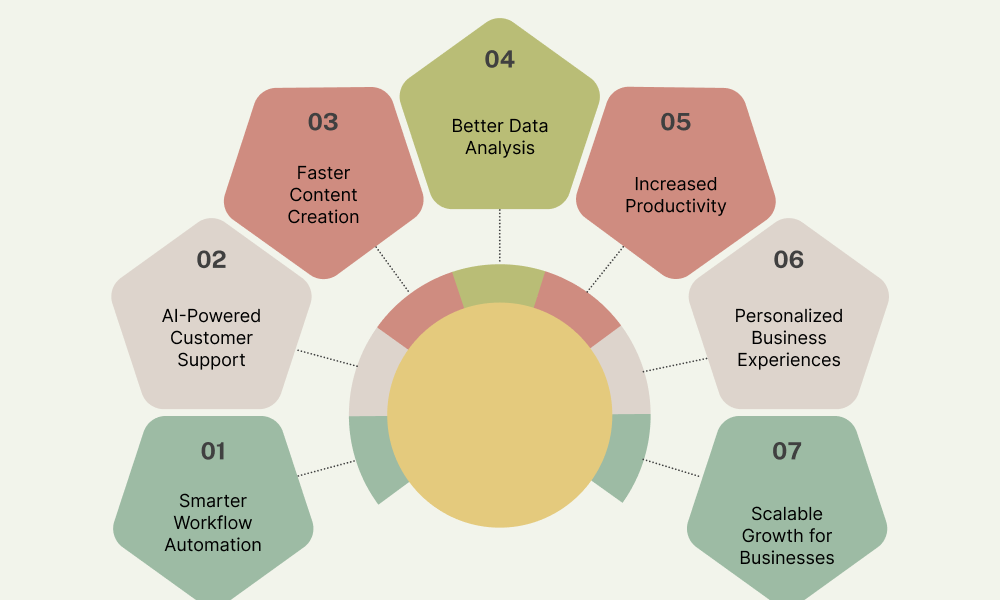
Smarter Workflow Automation
Generative AI solutions make business workflows more intelligent by automating repetitive tasks such as scheduling, approvals, document handling, and communication. With cloud-based online software solutions, teams can access automated systems anytime and from anywhere.
AI-Powered Customer Support
Businesses are improving customer service through AI chatbots and virtual assistants that deliver fast, personalized responses. These intelligent systems help reduce wait times, increase satisfaction, and provide 24/7 support.
Faster Content Creation
Generative AI solutions can automatically create blogs, emails, product descriptions, reports, and social media content. This saves time for marketing and content teams while maintaining consistency and quality.
Better Data Analysis
Modern businesses collect huge amounts of data daily. AI-powered online software solutions can analyze this data instantly, summarize trends, and provide actionable insights that help leaders make smarter decisions.
Increased Productivity
By combining intelligent automation with generative AI, businesses can reduce manual workloads, minimize errors, and lower operational expenses. Employees can then focus on strategic and high-value tasks.
Personalized Business Experiences
Generative AI enables personalized recommendations, targeted campaigns, and customized communication based on customer behavior. This leads to better engagement and stronger customer relationships.
Scalable Growth for Businesses
Cloud-based online software solutions integrated with AI allow businesses to scale quickly without major infrastructure costs. Whether it is a startup or enterprise, automation can grow with the company.
Major Benefits of Generative AI in Intelligent Automation
Generative AI is bringing a new level of intelligence to modern automation systems. It goes beyond traditional rule-based processes by enabling businesses to create content, analyze information, make recommendations, and automate complex workflows with speed and accuracy. When integrated into intelligent automation, generative AI helps organizations improve efficiency, reduce costs, and deliver better experiences to customers and employees. Below are some of the major benefits of Generative AI in intelligent automation.
1. Increased Productivity and Efficiency
One of the biggest advantages of generative AI is its ability to automate repetitive and time-consuming tasks. Activities such as writing emails, creating reports, summarizing documents, processing requests, and responding to customer queries can be completed much faster with AI support. This allows employees to focus on strategic work, innovation, and decision-making rather than routine tasks.
2. Reduced Operational Costs
By automating manual processes, businesses can significantly lower operating expenses. Generative AI reduces the need for repetitive labor-intensive tasks, minimizes errors, and improves resource utilization. This means organizations can accomplish more work with fewer delays and lower costs.
3. Improved Accuracy
Manual work often leads to mistakes such as data entry errors, missed details, or inconsistent communication. Generative AI improves accuracy by processing information systematically and producing consistent outputs. Whether it is generating reports, handling customer inquiries, or managing documentation, AI helps reduce costly human errors.
4. Faster Decision-Making
Modern businesses generate large volumes of data every day. Generative AI can analyze this information quickly, summarize key findings, and provide actionable recommendations. This helps leaders make informed decisions faster and with greater confidence. For example, AI can identify sales trends, customer preferences, operational bottlenecks, or market opportunities in real time, allowing companies to respond quickly.
5. Enhanced Customer Experience
Customer expectations continue to rise, and businesses need faster, smarter service. Generative AI supports intelligent automation through AI chatbots, virtual assistants, and personalized communication tools. These systems can answer questions instantly, guide customers through processes, and provide relevant solutions anytime.
This leads to shorter wait times, higher satisfaction levels, and stronger customer relationships.
6. Personalized Communication
Generative AI allows businesses to create highly personalized customer experiences. It can generate custom emails, targeted promotions, product recommendations, and personalized messages based on customer behavior and preferences.
This level of personalization improves engagement, increases conversion rates, and helps brands build loyalty with their audience.
7. Scalable Business Operations
As businesses grow, managing increasing workloads becomes challenging. Generative AI enables companies to scale operations efficiently without needing to expand teams at the same pace. Automated systems can handle higher volumes of customer requests, content creation, data processing, and workflow management with ease.
How Businesses Can Start with Generative AI Solutions
Adopting Generative AI solutions can help businesses improve productivity, reduce manual workloads, enhance customer experiences, and accelerate digital transformation. However, successful implementation requires a clear strategy rather than rushing into technology adoption without planning. Businesses should take a structured approach to ensure they gain maximum value from AI investments. Below are important steps organizations can follow to start with Generative AI solutions effectively.
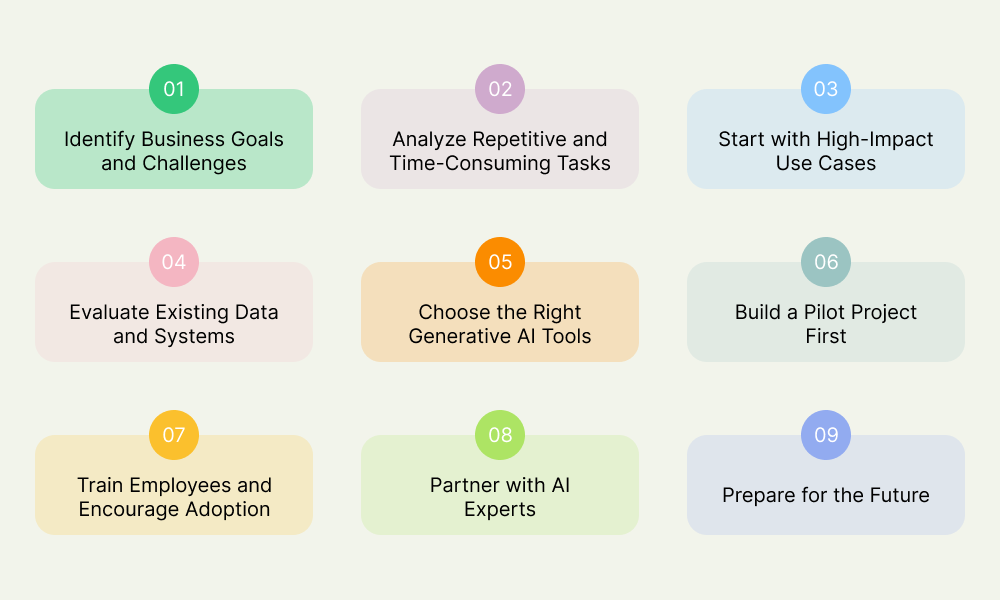
Identify Business Goals and Challenges
The first step is to understand why the business wants to adopt Generative AI. Companies should identify their key challenges, inefficiencies, and growth opportunities. AI should solve real business problems rather than being used simply because it is a popular trend.
Analyze Repetitive and Time-Consuming Tasks
Generative AI is most valuable when applied to processes that consume significant time and resources.Businesses should review departments such as customer service, marketing, HR, finance, sales, and operations to identify repetitive tasks that can be automated.
Start with High-Impact Use Cases
Rather than trying to transform every process at once, businesses should begin with a few practical use cases that offer clear returns. Starting small reduces risk and helps teams learn how AI fits into workflows.
Evaluate Existing Data and Systems:
Generative AI performs best when supported by clean, organized, and relevant data. Businesses should assess their current systems, databases, workflows, and software platforms before implementation. Strong data foundations lead to better AI performance and smoother automation.
Choose the Right Generative AI Tools
There are many AI platforms available, ranging from general-purpose tools to industry-specific solutions. Businesses should choose tools based on their needs, budget, security requirements, and scalability goals. The right technology partner can make implementation faster and more successful.
Build a Pilot Project First
Before scaling across the organization, businesses should launch a pilot project. A pilot allows companies to test AI capabilities in a controlled environment, measure results, and identify challenges.
Train Employees and Encourage Adoption
Technology alone does not create success. Employees need to understand how to use Generative AI tools effectively. Businesses should provide training programs, practical demonstrations, and clear guidance on how AI supports daily work. It is important to position AI as a tool that enhances human productivity rather than replacing people.
Partner with AI Experts
Many businesses benefit from working with experienced AI solution providers. Experts can help with strategy, implementation, customization, training, integration, and ongoing support. This reduces technical challenges and accelerates return on investment.
Prepare for the Future
Generative AI is evolving quickly. Businesses should view adoption as an ongoing journey rather than a one-time project. Companies that continuously learn, adapt, and innovate with AI will remain competitive in the digital economy.
Challenges Businesses Must Consider
While Generative AI offers powerful advantages for intelligent automation, businesses must also understand the challenges that come with adopting this technology. Successful implementation requires planning, responsible usage, and continuous monitoring. Organizations that address these challenges early can reduce risks and gain better long-term results.
Data Privacy and Security:
Generative AI systems often rely on large amounts of business and customer data to function effectively. This can include sensitive information such as financial records, customer details, internal documents, or operational data. If not managed properly, businesses may face privacy risks or data breaches.
Accuracy and Reliability of Outputs:
Although generative AI can produce impressive results, it may sometimes generate inaccurate, misleading, or incomplete information. This is especially important in industries such as healthcare, finance, legal services, or customer support where precision matters.
Integration with Existing Systems:
Many organizations already use multiple software platforms, databases, and operational tools. Integrating Generative AI with existing systems can be technically complex and may require custom development.
Cost of Implementation:
Although AI can reduce long-term costs, the initial investment may include software licensing, infrastructure upgrades, staff training, and customization expenses. Small and medium-sized businesses may need to plan carefully before adopting advanced AI solutions.
Future Trends in Generative AI and Intelligent Automation
The future of intelligent automation is being shaped rapidly by Generative AI. As technology advances, businesses will move beyond simple task automation toward highly adaptive, self-improving, and intelligent systems. Companies that prepare for these trends will gain a major competitive advantage.
Hyperautomation Across Businesses
Hyperautomation refers to automating complete end-to-end business processes rather than individual tasks. Generative AI will play a key role by managing workflows, generating content, analyzing data, and coordinating decisions across departments.
Autonomous AI Agents
Future businesses will increasingly use AI agents that can complete tasks independently with minimal supervision. These systems may schedule meetings, manage emails, create reports, monitor operations, or coordinate internal processes automatically.
Human-AI Collaboration
Rather than replacing people, the future will focus on collaboration between employees and AI systems. Workers will use AI assistants to brainstorm ideas, summarize research, generate content, and improve workflows. This partnership will help teams become more creative, efficient, and strategic.
Real-Time Adaptive Automation
Traditional automation follows fixed instructions. Future intelligent automation systems will adapt instantly based on changing conditions, customer behavior, market trends, or operational needs.
Multimodal AI Systems
Next-generation Generative AI will work across multiple formats including text, voice, image, video, and data simultaneously. Businesses will use multimodal AI for smarter customer support, advanced analytics, training content, and interactive user experiences.
Personalized Customer Journeys
Future automation will deliver highly personalized experiences at scale. AI will understand preferences, behavior patterns, and buying intent to generate customized recommendations, offers, and communication in real time.
Smarter Decision Intelligence
Generative AI will move beyond content creation into advanced business strategy support. It will simulate scenarios, forecast risks, recommend actions, and provide executive-level insights.
AI-Powered Software Development
Software creation will become faster through AI-generated code, testing, debugging, and documentation. Businesses will launch products quicker and improve digital services with lower development effort. This trend will especially benefit startups and technology-driven companies.
Conclusion
Generative AI solutions are transforming intelligent automation by enabling businesses to work smarter, faster, and more efficiently. From automating repetitive tasks and improving customer service to enhancing decision-making and driving innovation, these technologies are helping organizations stay competitive in a rapidly evolving digital world. When combined with advanced online software solutions, businesses can unlock new levels of productivity, scalability, and growth.
At jiWebTech, we specialize in delivering innovative customized Generative AI solutions that help businesses embrace the future of intelligent automation. Our goal is to empower organizations with smart technologies that streamline operations, improve performance, and create long-term success. Partner with jiWebTech to take your business toward a more intelligent and automated future.
Frequently Asked Question
1. What are Generative AI solutions?
Generative AI solutions are advanced artificial intelligence technologies that can create original content, automate tasks, and generate human-like responses based on learned data patterns. They are widely used to improve business productivity and innovation.
- Create text, images, code, and reports
- Automate repetitive business processes
- Improve efficiency and creativity
2. How do Generative AI solutions improve intelligent automation?
Generative AI adds intelligence and adaptability to automation systems. It helps businesses automate more complex tasks such as customer communication, content creation, and data analysis.
- Enhances workflow automation
- Improves decision-making speed
- Reduces manual effort and errors
3. Which industries can benefit from Generative AI solutions?
Many industries are using Generative AI solutions, including healthcare, finance, retail, education, manufacturing, and customer service.
- Streamlines operations across sectors
- Improves customer experiences
- Supports digital transformation
4. Are Generative AI solutions suitable for small businesses?
Yes, Generative AI solutions are valuable for small businesses because they help save time, reduce costs, and improve efficiency without requiring large teams.
- Affordable automation options available
- Supports business growth
- Enhances productivity with fewer resources
5. What are online software solutions in AI automation?
Online software solutions are cloud-based platforms that help businesses access AI tools, automate workflows, manage operations, and improve collaboration from anywhere.
- Easy remote access
- Scalable for growing businesses
Integrates with modern AI systems
6. Why choose jiWebTech for Generative AI solutions?
jiWebTech provides customized Generative AI solutions and online software solutions designed to help businesses automate operations, increase efficiency, and achieve long-term growth.
- Tailored AI solutions for businesses
- Expert technology support
- Focus on innovation and results